Owen Goonan was born on the extreme west coast of Ireland, a place he often describes as one of raw beauty, with its ever-changing skies, lonely cotton boglands, and empty Atlantic beaches. He began his working life in various Government departments as a civil servant, before moving into retail, first as a gift shop owner and later in the world of floristry, where he established a high-class chain of shops known as The Darling Buds of May.
Today, he has turned his focus fully to writing, drawing on a lifetime of experience to record the people, places and memories of a vanishing Ireland. His work reflects a deep attachment to landscape, identity and the passing rhythms of Irish life, preserving moments and voices that might otherwise be lost to time.
He is an Irish author whose writing is rooted in memory, place and the lives of ordinary people. His work draws deeply on the social history of Ireland, on personal experience, and on the quieter moments that reveal resilience, humour and humanity. Across his books he explores belonging, loss, migration, endurance and the search for meaning, always with a strong sense of landscape and the changing character of Irish life.
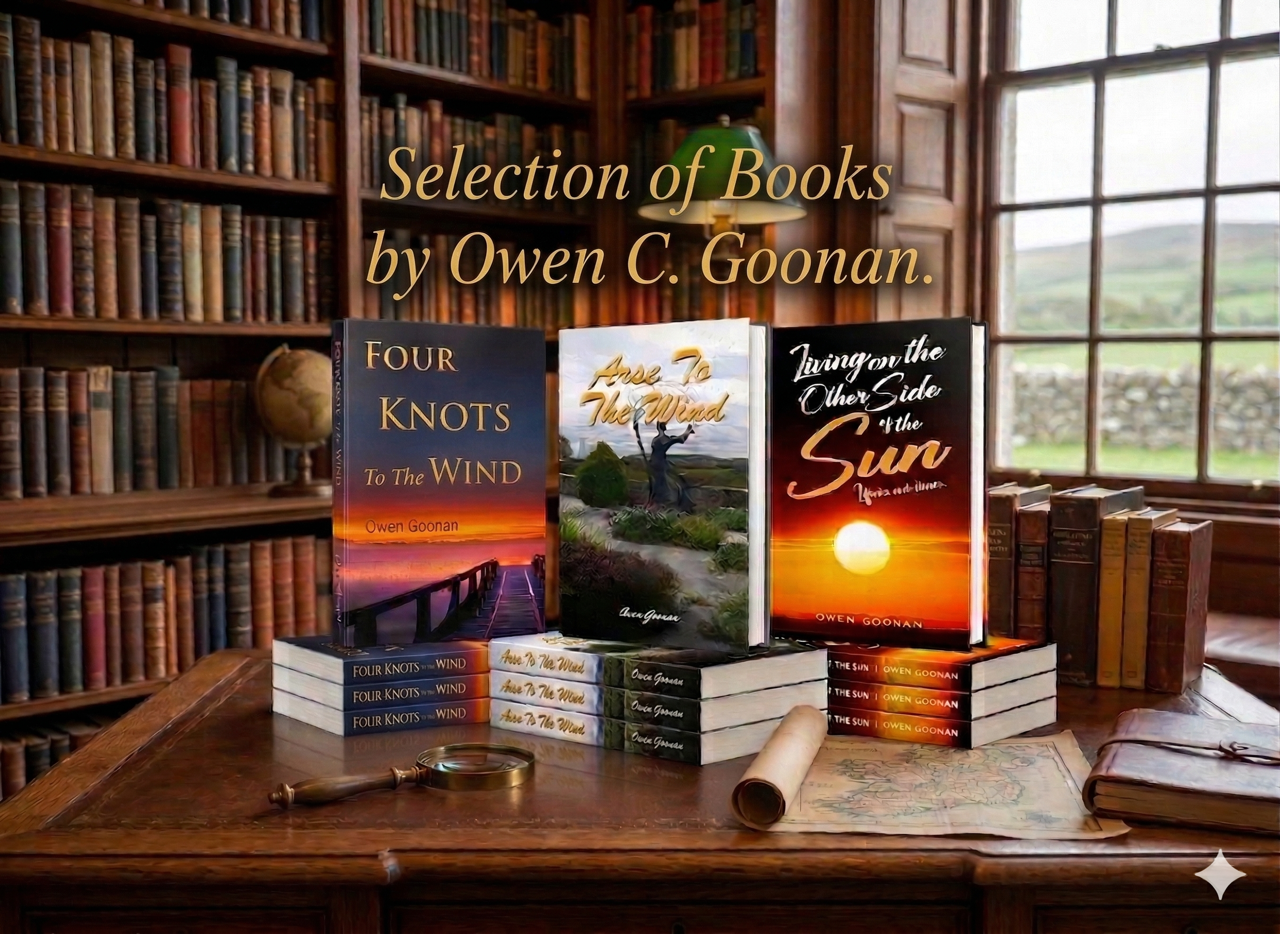
His first book, Arse to the Wind, is a biography of growing up in Ireland during the 1960s. It recalls a time when self-sufficiency was often the order of survival, when emigration shaped families and communities, when schools were governed by the iron fist of discipline, and when the authority of the Church reached deeply into everyday life. Through personal recollection and observation, the book captures both the hardships and the richness of that era, offering an honest and vivid portrait of a country and a generation.
He is also the author of Living on the Other Side of the Sun, a reflective and evocative work exploring themes of memory, distance, and the emotional landscapes of lives shaped by change and experience.
His second novel, Four Knots to the Wind, is a haunting and deeply human story about individuality, belonging, and the quiet courage it takes to live differently. Set in a quiet corner of the west of Ireland, where the Atlantic wind shapes both land and destiny, it follows Joe — a man who lives life on his own terms. To some he is a curiosity, to others a symbol of a freedom long forgotten, but to those who know him, he is something far more complex. When Joe suddenly disappears, the mystery unsettles the small community around him. The investigation falls to detective John Coffey, whose search for answers draws him into the rhythms, silences, and hidden stories of Shanagarra, revealing that some lives cannot be measured by ordinary standards, and some disappearances say as much about the living as the lost.
His forthcoming book, Where Have All the Flowers Gone, is due for publication shortly. A poignant and deeply human novel, it follows a man’s struggle with life, the futility of war, and the lasting wounds of rejection and isolation. Shaped by memories of folk singer Pete Seeger and by the moral shadows of the Vietnam War, the story traces his attempt to escape by sea, only to discover that distance cannot silence the deeper questions of belonging, identity and peace.